
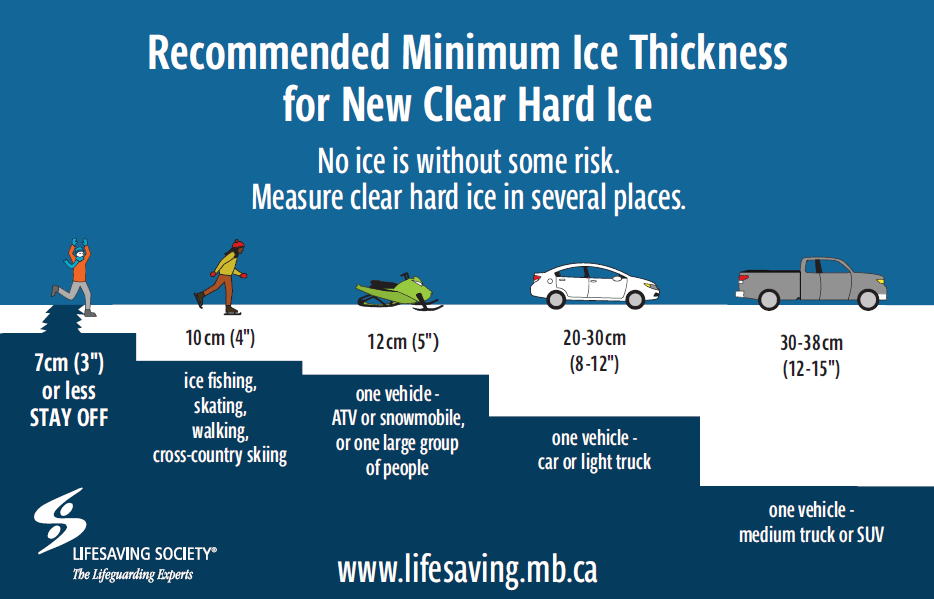
Test it first! … drill a hole and measure the ice before venturing out onto any frozen waterbody/waterway!
Ice formation – Generally, small lakes and slow-moving streams freeze over earlier than larger lakes or fast-moving streams. While there are many different types of ice, the type presented below are the most important:
- NATURAL ICE OR CLEAR BLUE ICE: formed by the freezing of water
- WHITE ICE OR SNOW ICE: formed when water-saturated snow freezes on top of ice, making an opaque white ice which is not as strong as clear ice. It is white because it contains numerous small air bubbles.
- CONSTRUCTED FLOOD ICE: ice constructed by pumping water directly on the surface of a bare ice sheet to build ice on the top of the ice sheet. Uniformity and quality depend on construction practices and can once completely frozen and inspected by considered as having similar strength to nature ice (assuming sound construction practices).
- ICE COLOR: Color ranges from blue to white to grey and provides an indication of quality and strength. NATUAL ICE – CLEAR BLUE ICE: It’s blue because its clear enough to see the water underneath – very few air bubble. WHITE/SNOW ICE – has high air content and strength depends on density. GREY ICE – indicates presence of water as a result of thawing and must be considered to be highly suspect – do not consider as a safe load-bearing surface.